ASTM International represents the global leadership in developing and delivering international voluntary consensus standards. Currently, more than 12,000 ASTM standards are used around the world as a base to improve product quality, enhance safety, facilitate market access and trade, and build consumer confidence.
As an active member, eralytics is involved in the development of international ASTM standards. We do not just build analyzers that comply with international standards, we actively write and define them. It is essential that our analytical instruments comply with international standards such as ASTM, ISO, IP and others to ensure accurate, reliable and comparable results across different industries.
Decades of expertise – Contribution to ASTM standards
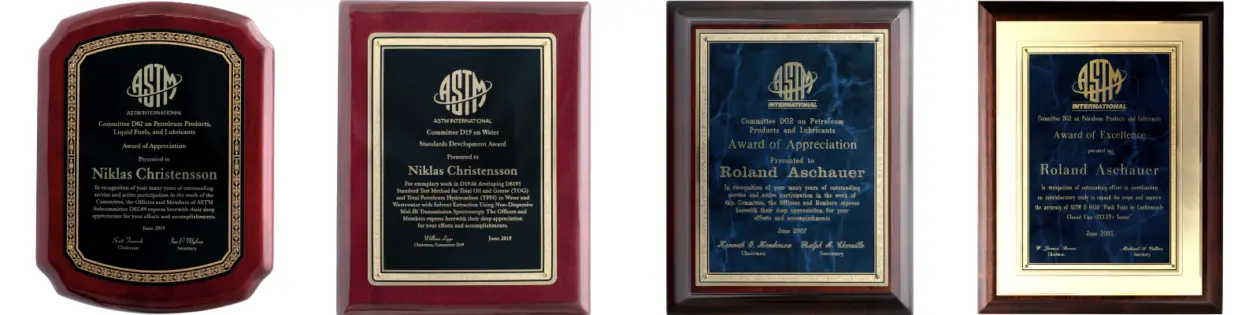
Our industry experts including Dr. Niklas Christensson (CEO eralytics), Dr. Roland Aschauer (R&D eralytics), Andreas Schwarzmann (R&D eralytics), Ernst Hamann and the marketing and sales specialist Philipp Jordan contribute their decades of experience to the development of robust, safe, and highly precise analytical methods. Their direct involvement ensures that critical testing methodologies, particularly those in the field of flash point testing, vapor pressure testing, FTIR analysis and oil-in-water testing successfully pass the rigorous development, voting, and validation processes required by ASTM International.
If an eralytics analyzer is labeled as “ASTM-compliant,” it is a sign of independent verification. This indicates that our technologies and analyzers meet international, reliable industry standards and have been officially tested and certified.
ASTM Standards established by eralytics
eralytics has been at the forefront of developing several key international test methods. We are the leading developers behind the following ASTM standards:
- ASTM D5845: Standard Test Method for Determination of MTBE, ETBE, TAME, DIPE, Methanol, Ethanol and tert-Butanol in Gasoline by Infrared Spectroscopy (Developed by Dr. Roland Aschauer)
This standard utilizes mid-infrared spectroscopy to provide highly accurate, quantitative results in seconds. Its unmatched precision and speed make it ideal for both laboratory quality control and portable on-site field testing. - ASTM D6277: Standard Test Method for Determination of Benzene in Spark-Ignition Engine Fuels Using Mid Infrared Spectroscopy (Developed by Dr. Roland Aschauer)
Based on a rugged mid-infrared interferometer, this method enables the rapid and precise determination of benzene directly at the point of sale. It serves as an excellent, portable solution to effectively combat global fuel adulteration, smuggling, and dilution. - ASTM D7094: Standard Test Method for Flash Point by Modified Continuously Closed Cup (MCCCFP) Tester. (Developed by Dr. Roland Aschauer and Andreas Schwarzmann)
This method utilizes a Modified Continuously Closed Cup design requiring only 1–2 mL of sample and no open flame, guaranteeing maximum laboratory safety. Extensive interlaboratory studies confirm it offers the best reproducibility of all available flash point methods, with no statistically significant bias compared to traditional methods like ASTM D93. - ASTM D8606 Standard Test Method for Finite Flash Point Determination of Liquid Wastes by Modified Continuously Closed Cup (MCCCFP) Tester (Developed by Andreas Schwarzmann)
This standard establishes a reliable and inherently safer framework for testing the ignitability of unpredictable liquid wastes between -25 °C and 90 °C. By utilizing a continuously closed chamber with a minimal 2 mL sample volume and no open flame, it drastically reduces laboratory fire hazards. - ASTM D7806: Standard Test Method for Determination of Biodiesel (Fatty Acid Methyl Ester) and Triglyceride Content in Diesel Fuel Oil Using Mid-Infrared Spectroscopy (FTIR Transmission Method).(Developed by Dr. Niklas Christensson)
This method enables the highly accurate and rapid determination of Biodiesel (FAME) concentrations in conventional diesel fuel in a matter of seconds. - ASTM D8193: Standard Test Method for Total Oil and Grease (TOG) and Total Petroleum Hydrocarbon (TPH) in Water and Wastewater with Solvent Extraction Using Non-Dispersive Mid-IR Transmission Spectroscopy (Developed by Dr. Niklas Christensson, CEO eralytics)
This method provides a highly efficient, reliable, and standardized framework for accurately measuring oil and grease contamination in water to ensure strict environmental and regulatory compliance.
Contribution to ISO-Standard ISO 24966
While ASTM relies on the consensus and voting of individual experts in technical committees, the International Organization for Standardization (ISO) utilizes a similar hierarchical committee structure that is staffed by official representatives of national standardization institutes (such as DIN in Germany). The publication of the ISO 24966 standard demonstrates that the MCCCFP technology pioneered by eralytics has not only succeeded in independent expert circles but has also been officially adopted at the highest national level as a globally recognized standard.
- ISO 24966: Determination of flash point – Modified Continuously Closed Cup Flash Point (MCCCFP) Method (Developed by Andreas Schwarzmann)
This test method sets a new global benchmark for laboratory safety, speed, and precision by utilizing continuously closed cup technology. It provides highly reliable results equivalent to traditional open-flame methods like ISO 2719 and ASTM D93 while completely eliminating fire hazards.
Commitment to Uncompromising Quality – Interlaboratory Studies for ASTM D7094 and more
To guarantee the highest level of precision and bias evaluation, we regularly organize and participate in extensive interlaboratory studies (Round Robin tests). Our successfully completed projects in this area include:
- Organizing the official Round Robin study for ASTM D7094.
- Active participation in the completed Round Robin studies for ASTM D6377, ASTM D6378, ASTM D5188, and ASTM D6897
By continuously advancing these standards, eralytics ensures that laboratories worldwide can rely on the safest, fastest, and most accurate testing methods and analyzers available today.