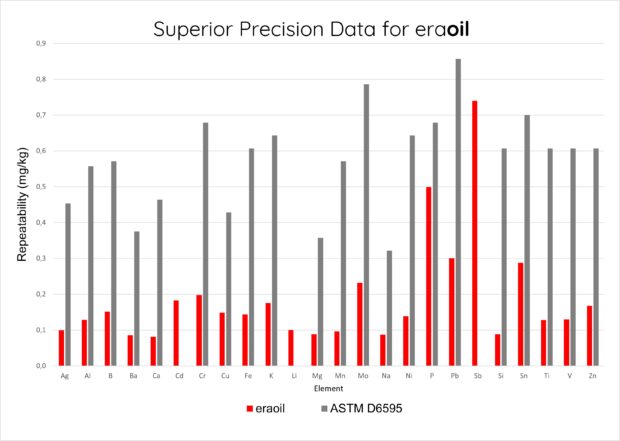
eraoil is the first and most advanced stand-alone rotating disc electrode spectrometer analyzing wear metals, additives, and contaminants in all kinds of operating liquids, like lubricating oils, heavy fuel oil, fuels, coolants, process water, etc. Up to 32 elements are measured fully automatically within 30 seconds. eraoil’s high-end CMOS detector in combination with the automatic background correction allow for a sub-ppm detection limit (LOD) for most elements.
eraoil at a glance
360° View
Standards
Smallest footprint with built-in PC
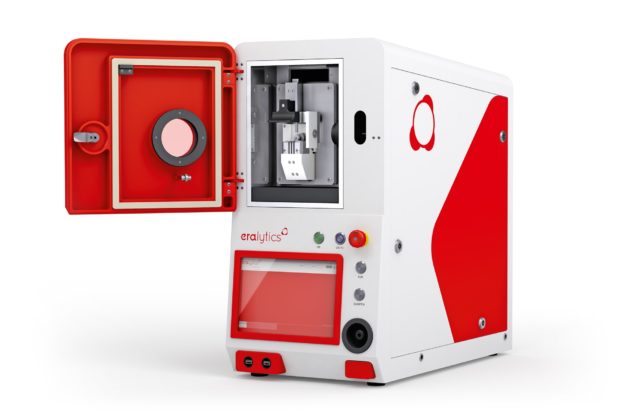
eraoil’s unique stand-alone design offers a rugged all-in-one package for operation even in the smallest on-site testing labs. It comes with a built-in 10” color touchscreen and a PC. Even an electrode sharpener and an automatic ventilation system are integrated into the eraoil. Still, it is the RDE-OES analyzer with the smallest footprint on the market. eraoil is very easy to use even for untrained operators. The automated measuring procedure follows simple steps and is therefore perfect for on-site inspection: Just fill the sample cup, close the door, and push the start button. The elemental concentration is available immediately.
High-precision oil and fuel analysis
eraoil is fully compliant with ASTM D6595 (oil) and ASTM D6728 (fuel). ASTM D6595 is the standard for identifying wear metals and contaminants in used lubricating oils and used hydraulic fluids by rotating disc electrode optical emission spectrometry. For determinating contaminants in gas turbine and diesel engine fuel, ASTM D6728 is the standard of choice. To protect finished fuels against trace contamination eraoil is available with the special Low Detection Fuel Module to detect e.g. Potassium, Lithium, Sodium and Vanadium at LOD levels of as low as 0.1 ppm.
scroll to see more images
gallery controls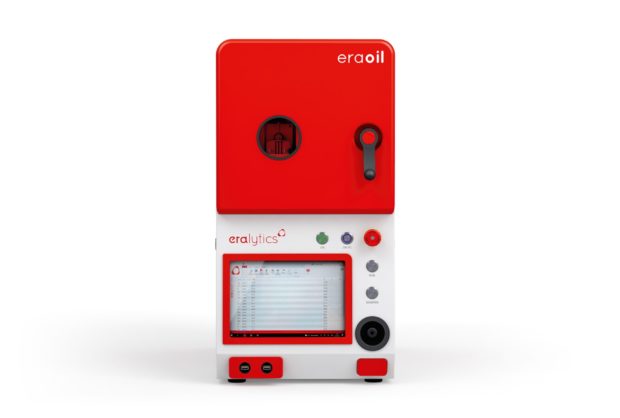
Applications for the spectrometer eraoil
Multi-elemental analysis is the core of in-service oil analysis. Thus eraoil is the perfect solution for wear metal analysis of lubricants from engines, transmissions, hydraulic systems and gears boxes. The fast and easy elemental analysis brings clear advantages for the operation of any commercial means of transport or machines in the industrial environment. This solution also offers clear added value for other applications such as coolants, metal working fluids, or any other process fluids.

Your features at a glance
- Analyzing wear metals, contaminants, and additives in lubricating oils and hydraulic fluids according to ASTM D6595 and contaminants in gas turbine and engine fuel according to ASTM D6728
- Up to 32 elements in 30 seconds with sub-ppm LOD
- Stand-alone design with built-in PC, touchscreen, sharpener & ventilation
- Smallest and most rugged housing for lab and on-site applications
Operation video of eraoil
Watch this video to find out how easy it is to use eraoil. Taking measurements for oil and grease samples and filling the sample couldn’t be easier.
Wear metals and contaminants
| Element | Lubricant ASTM D6595 | Lubricant Ext. Element ASTM D6595 | Lubricant Ext. Range ASTM D6595 | Fuel ASTM D6728 | Low Detection Fuel | Coolant | Water |
|---|---|---|---|---|---|---|---|
| Silver (Ag) | 0 – 1000 | 0 – 1000 | 0 – 1000 | 0 – 10 | |||
| Aluminium (Al) | 0 – 1000 | 0 – 1000 | 0 – 1000 | 0 – 1000 | 0 – 100 | 0 – 50 | 0 – 10 |
| Arsenic (As) | 0 – 100 | ||||||
| Boron (B) | 0 – 1000 | 0 – 1000 | 0 – 1000 | 0 – 1000 | 0 – 10 | ||
| Barium (Ba) | 0 – 1000 | 0 – 1000 | 0 – 6000 | ||||
| Bismuth (Bi) | 0 – 1000 | 0 – 1000 | 0 – 1000 | ||||
| Calcium (Ca) | 0 – 1000 | 0 – 1000 | 0 – 6000 | 0 – 1000 | 0 – 100 | 0 – 50 | 0 – 10 |
| Cadmium (Cd) | 0 – 1000 | 0 – 1000 | 0 – 1000 | 0 – 10 | |||
| Cerium (Ce) | 0 – 100 | ||||||
| Cobalt (Co) | 0 – 100 | 0 – 10 | |||||
| Chromium (Cr) | 0 – 1000 | 0 – 1000 | 0 – 1000 | 0 – 1000 | 0 – 100 | 0 – 10 | |
| Copper (Cu) | 0 – 1000 | 0 – 1000 | 0 – 1000 | 0 – 1000 | 0 – 100 | 0 – 50 | 0 – 10 |
| Iron (Fe) | 0 – 1000 | 0 – 1000 | 0 – 1000 | 0 – 1000 | 0 – 100 | 0 – 50 | 0 – 10 |
| Indium (In) | 0 – 1000 | 0 – 1000 | 0 – 1000 | ||||
| Potassium (K) | 0 – 1000 | 0 – 1000 | 0 – 1000 | 0 – 1000 | 0 – 100 | 0 – 1000 | 0 – 10 |
| Lithium (Li) | 0 – 1000 | 0 – 1000 | 0 – 1000 | 0 – 1000 | 0 – 100 | ||
| Magnesium (Mg) | 0 – 1000 | 0 – 1000 | 0 – 6000 | 0 – 1500 | 0 – 300 | 0 – 50 | 0 – 10 |
| Manganese (Mn) | 0 – 1000 | 0 – 1000 | 0 – 1000 | 0 – 1000 | 0 – 100 | 0 – 10 | |
| Molybdenum (Mo) | 0 – 1000 | 0 – 1000 | 0 – 1000 | 0 – 500 | |||
| Sodium (Na) | 0 – 1000 | 0 – 1000 | 0 – 6000 | 0 – 1000 | 0 – 100 | 0 – 1000 | 0 – 10 |
| Nickel (Ni) | 0 – 1000 | 0 – 1000 | 0 – 1000 | 0 – 1000 | 0 – 100 | 0 – 10 | |
| Phosphorus (P) | 0 – 1000 | 0 – 1000 | 0 – 6000 | 0 – 2500 | 0 – 10 | ||
| Lead (Pb) | 0 – 1000 | 0 – 1000 | 0 – 1000 | 0 – 1000 | 0 – 100 | 0 – 50 | 0 – 10 |
| Antimony (Sb) | 0 – 1000 | 0 – 1000 | 0 – 1000 | ||||
| Silicon (Si) | 0 – 1000 | 0 – 1000 | 0 – 1000 | 0 – 1000 | 0 – 100 | 0 – 500 | 0 – 10 |
| Tin (Sn) | 0 – 1000 | 0 – 1000 | 0 – 1000 | 0 – 10 | |||
| Strontium (Sr) | 0 – 100 | ||||||
| Titanium (Ti) | 0 – 1000 | 0 – 1000 | 0 – 1000 | ||||
| Vanadium (V) | 0 – 1000 | 0 – 1000 | 0 – 1000 | 0 – 1000 | 0 – 100 | ||
| Tungsten (W) | 0 – 100 | ||||||
| Zinc (Zn) | 0 – 1000 | 0 – 1000 | 0 – 6000 | 0 – 1000 | 0 – 100 | 0 – 50 | 0 – 10 |
| Zirconium (Zr) | 0 – 100 | ||||||
| Total | 26 | 32 | 26 | 15 | 15 | 13 | 19 |
eraoil in detail
Technical Specifications for eraoil
- Available Test Methods
- ASTM D6595: Wear metals, contaminants, and additives in used lubricating oils and hydraulic fluids
ASTM D6728: Contaminants in gas turbine and engine fuel - Correlation to
- ASTM D5185 (ICP-AES)
- Spectrometer Type
- Rotating Disc Electrode Spectrometer (190 – 810nm)
Thermally stabilized Paschen-Runge mounting with CMOS detectors - Measurement Parameter
- Elemental concentrations in ppm (mg/kg)
- Applications
- Determination of additives, wear metals, and contaminants in lubricating oils,
hydraulic fluids, gas turbine & diesel engine fuel, heavy fuel oil (HFO), crude oil,
glycol coolants, process water, mineral water, and grease - Analytical Range
- Simultaneous measurement of up to 32 elements in 30 seconds with a sub-ppm detection limit (LOD) for most elements incl. automatic background correction
- Calibration
- Factory calibrated for 26 elements, optional calibration for up to 32 elements and optional JOAP calibrations
- Sample Volume
- 2 mL; no solvents, reagents or gases are needed, no cleaning of cell window
- Operating Conditions
- 0 °C to 40 °C (32 °F to 104 °F)
Up to 90% humidity, non-condensing - Fully Integrated Stand-Alone Design
- Built-in electrode sharpener and ventilation system
Industry-proven multilingual 10” color touchscreen
Built-in PC with Ethernet, USB, and RS232 interfaces
Optional connection of a monitor and data input by external keyboard, mouse, or barcode reader - Software
- Windows® software for convenient data transfer, viewing spectra, and result analysis
- Result Database
- Over 100,000 detailed test reports and spectra storable in internal memory
- Dimensions & Weight
- (W x D x H) = 36.0 x 66.0 x 69.5 cm (14.2 x 26.0 x 27.4 in) / 85 kg (187 lb)
- Power Requirements
- 90 – 270 V, AC 50/60 Hz, 500 W
- Recommended Consumables for 1000 Tests
- EOL01 – A001 graphite discs (1000 pcs)
EOL01 – A002 graphite electrodes (100 pcs)
EOL01 – A003 2 ml sample cups (1000 pcs)
Downloads for eraoil
Brochure
- eralab OCM – Overview of Oil Condition Monitoring Analyzers (English, PDF, 3 MB)
- eraoil: RDE-OES Spectrometer (English, PDF, 2 MB)
White Paper
Frequently Asked Questions about eraoil
We recommend a preventive maintenance schedule every 6 months according to the user manual. Every 24 months, a complete service should be performed by a qualified technician or the eralytics support team to ensure long-term instrument precision reliability. Regular maintenance is essential for ensuring the high performance of your equipment. While basic preventive steps can be managed internally on a 6-month cycle, the 24-month interval is a deep-dive service conducted by experts. These procedures ensure your device remains compliant with industry standards and continues to deliver reliable results.
Key maintenance activities include:
– Comprehensive visual inspections of all specified components
– Installation of the latest software updates to improve functionality
– Execution of the Initial Qualification Test (IQT) for verification
– Replacement of wear-and-tear parts by certified personnel
If you need further assistance, contact our service and support team >>
eraoil measures various liquid samples with a viscosity up to 2500 mm²/s at anbient conditions and a flash point above 50°C. For accurate results, particles should not be bigger than 10 μm. To ensure the highest precision, samples should meet specific physical criteria. High viscosity or large particulate matter can interfere with the sample’s transport to the spark, leading to under-reported elemental concentrations.
Key limitations and preparation requirements include:
– Particle size: Particles over 10 μm may not be effectively vaporized by the rotating disc electrode
– Viscosity: The system supports liquids up to 2500 mm²/s @ 20°C. Samples exceeding this limit must be diluted before testing
– Flash point: For safety and performance, samples with a flash point below 50°C require dilution
eraoil is designed exclusively for liquid sample analysis to ensure consistent electrode contact. If you need more information, please contact our service and support team >>
The instrument comes already factory calibrated and does not require further calibration by the user. However, operators have to perform regular validation checks to ensure precision which may lead to a required standardization. Validation check is essintial for reliable elemental analysis. We recommend using the “V26-100” standard, though other CRMs are compatible. Following ASTM D6595 guidelines ensures your data remains accurate throughout operation.
This may happen over time due to drifts in electronic components, but mainly due to changes in the environmental conditions. Perform a validation check to confirm performance. If any measured element deviates by more than ±10% from its reference value, the check has failed. In this case, a standardization is required to counteract drift and restore accuracy. If your results fall outside this range, follow these steps:
– Consult the manual: Detailed step-by-step instructions for the standardization procedure are available in your eraoil user manual
– Inspect hardware: Check the lens and spark stand for cleanliness, as residue can cause significant measurement offsets
– Verify standards: Ensure that your “V26” or other CRM standards are not expired or contaminated
– Run a standardization: This process adjusts the instrument’s response to re-align with the original factory calibration
By maintaining these measures, it is guaranteed that your eraoil analysis remains compliant with ASTM D6595. If you need more information, please contact our service and support team >>
Maintain your device through regular cleaning: wipe the disc and sample cup holders before every test, empty the sharpener drawer if required, and perform a deep clean of the lens and sample chamber at least once a month. Preventing sample carryover and graphite dust accumulation ensures the optical path remains clear and the electronics stay protected. Don’t use aggressive chemicals on painted housing surfaces. If you need more information concerning cleaning, please contact our service and support team >>
eraoil includes an integrated ventilation system to safely vent exhaust gases and a door-interlock safety mechanism. This ensures that the high-energy spark only activates when the chamber is sealed, protecting the operator at all times. Designed for demanding laboratory and field environments, the eraoil prioritizes both user safety and atmospheric integrity. Because the analysis involves vaporizing approximately 0.5 mL of oil per test, managing the resulting combustion byproducts is critical.
Key safety components include:
– Built-in ventilation: An internal extraction system captures exhaust gases generated during the spark process and directs them through a dedicated outlet at the rear of the device for external venting
– Spark interlock system: To prevent accidental exposure to high-voltage discharge, the instrument features an electronic sensor. The spark will not generate if the door is open; if opened during a measurement, the spark terminates instantly. If you need more information, please contact our service and support team >>