eravisc X
The smallest kinematic viscometer.
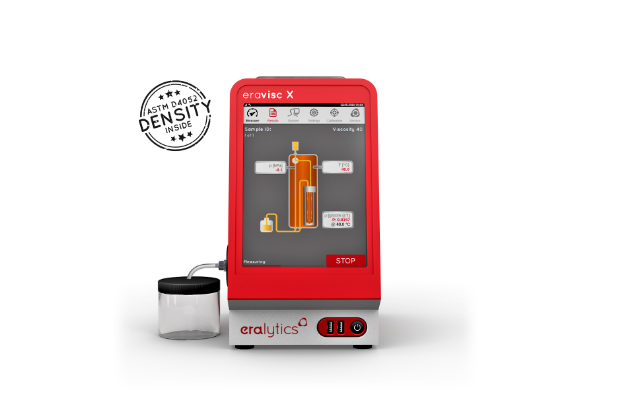
eravisc X is the world‘s smallest and most rugged kinematic viscometer measuring viscosity with lab-grade precision meeting ASTM D445 and ASTM D7042. Its revolutionary viscosity cell is combined with eralytics unique x-oscillating metal U-tube density cell. This allows an independent high-precision density measurement in full compliance with ASTM D4052 and ISO 12185.
360° View
Xtra easy & fast
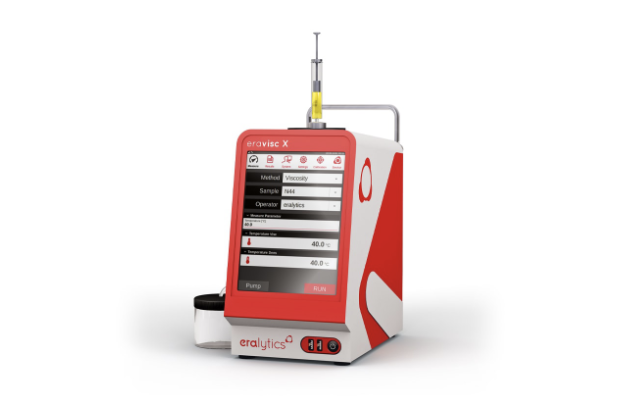
The fully automated measurement of the kinematic viscosity at 40 °C or at 100 °C takes only 1 minute. Results are displayed on the large color touchscreen and can be printed, exported via USB or directly transferred to a PC or LIMS via an Ethernet connection. With its unique sample introduction from the top the viscometer eravisc X is equally easy to operate for right-handed and left-handed persons.
Xtra rugged
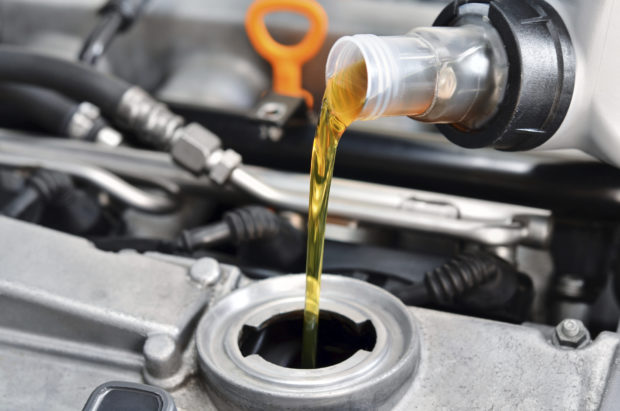
The viscometer eravisc X is built in a corrosion-resistant aluminum housing. Its robustness and reliability make it the ideal solution for daily viscosity measurements in the laboratory as well as directly in the field to immediately prove specification or detect contamination, and oil degradation. eravisc X is the perfect solution for highly accurate testing even under extreme conditions.
Xtra accurate & compact
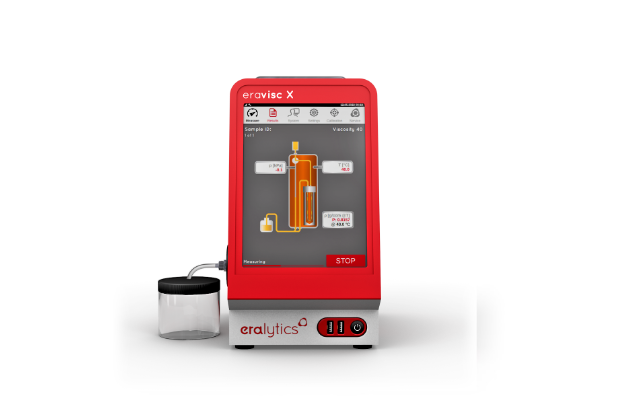
eravisc X’s revolutionary capillary measuring cell is a real game changer for high-precision kinematic viscosity testing at any temperature between 15 °C and 100 °C. Latest Peltier Technology allows for automated, high-speed viscosity index measurement. eralytics unique FillingProof® solution detects even smallest bubbles, ensuring maximum density accuracy. eravisc X is the analyzer with the smallest footprint on the market, still offering maximum ease of use and operator convenience. The compact dimensions and lightweight instrument design offer true portability on-site and require minimum bench space in the lab.
2 in 1: Viscosity & density testing with lab-precision
eravisc X allows for the independent measurements of viscosity and density enabling the simultaneous determination of both values at different temperatures. eralytics unique, dynamic capillary viscosity measurement method determines the flow time of the sample as a function of a rapidly measured pressure. This patented principle combines the advantages of traditional capillary methods with the speed and ease of use of eralytics instruments.
Your features at a glance
- The smallest and most rugged kinematic viscometer
- Lab-grade precision (ASTM D445 and ASTM D7042)
- Measurement of kinematic viscosity at 40 °C or at 100 °C in 1 minute
- Independent high-precision density measurement in full compliance with ASTM D4052 and ISO 12185
- Revolutionary capillary measuring cell
- FillingProof® Technology
eravisc X operation video
Watch this video to get an overview of the standard operation of eravisc X: It demonstrates how easy it is to use the analyzer, from filling the sample to measuring and simple follow-up steps.
Technical Specifications
- Available Test Methods
- Viscosity: Correlation to ASTM D445, D7042, D2270, ISO 3104, ISO 23581
Density: ASTM D4052, D5002, ISO 12185 - Special Operation Modes
- Viscosity Index (40 °C & 100 °C)
Simultaneous Viscosity & Density testing at independent temperatures - Measuring Range
- Viscosity: 1 – 1000 mm2/s | Density: 0 – 3 g/cm3
- Temperature Range
- Viscosity: 15 °C to 100 °C (59 °F to 212 °F) | Density: 0 °C to 100 °C (32 °F to 212 °F)
- Accuracy *
- Viscosity: 0.8 % | Density: 0.00005 g/cm3
- Repeatability (SD)*
- Viscosity: 0.25 % | Density: 0.000005 g/cm3
- Resolution
- Viscosity: 0.01 mm2 /s | Density: 0.00001 g/cm3
- Temperature Accuracy
- 0.02 °C (0.04 °F)
- Measurement Time
- 1 minute
- Sample Volume
- 3 mL
- Bubble Detection
- FillingProof® – automated bubble detection and bubble quantification
(Patent: US 11,493,417 B2) - Oscillating Tube (Density)
- Hastelloy (Patent: US 11,630,044)
- Viscosity Correction (Density)
- Yes – full range correction (Patent: AT523471 A1)
- Special Features
- Integrated fully-automated drying pump, built-in ambient pressure sensor
- Result Database
- Over 100 000 detailed test reports stored
- PC Software
- erasoft RCS – remote control Windows® software for multi-instrument remote control,
convenient data transfer, viewing spectra and result analysis
erasoft OCM software – supports operators in the management, operation and predictive maintenance of technical equipment with a focus on oil condition monitoring - Remote Service
- Remote service capability via Ethernet
- Interfaces
- Built-in PC with Ethernet, 4 x front and rear USB, RS232 interfaces, Wi-Fi via USB dongle
Direct LIMS connectivity via LAN, output to printer or PC, and export as CSV or PDF
Optional input by keyboard, mouse, and barcode reader - Display
- Industry-proven 8.4“ multilingual color touchscreen
- Power Requirements
- 85 – 264 V AC 47 – 63 Hz, max 150 W
- Operating Condition
- 5 °C – 45 °C up to 90 % rel. humidity (non-condensing)
- Dimensions & Weight
- (W x D x H) = 18.0 x 28.6 x 29.3 cm (7.1 x 11.2 x 11.5 in) / 8 kg (17.6 lb)
- *Typical values, depending on sample type and temperature and without consideration of the particular uncertainties of reference materials (CRM)
Downloads
Frequently Asked Questions
Samples must be fluid at room temperature, non-corrosive, and have a viscosity of up to 1000 mm²/s. To ensure high precision and protect the measurement cell, please consider the following:
• Viscosity: Supports all oil types up to 1000 mm²/s.
• Particles: Must be smaller than 0.4 mm and stable against sedimentation. Filter larger particles before injection.
• Temperature: Do not heat samples. They must be naturally fluid at ambient temperature.
• Restrictions: Avoid corrosive or crystallizing substances to prevent irreversible damage.
For more details visit the technical specifications of the kinematic viscometer eravisc X.
Bubble-free filling is crucial, as air can falsify density and viscosity data. The eravisc X uses the patented FillingProof® feature to ensure reliable, bubble-free results:
• Air Check: Measures air density to verify the cleanliness of the measurement cell before starting.
• FillingProof®: Since the density module volume is larger than the viscosity cell, this feature evaluates the entire fill for bubbles to guarantee data quality.
• Verification: Standard practice includes an average of two runs to verify that the sample is stable and homogeneous.
• Automated Warnings: Any presence of air bubbles during the FillingProof® filling sequence triggers an immediate warning.
This multi-step approach ensures maximum precision for every measurement. You need more on that? Just contact our technical team.
Standardize your preparation by homogenizing and degassing samples to ensure bubble-free filling and high precision. While diesel requires no pre-treatment, used oils and high-viscosity samples demand a careful process to prevent FillingProof® warnings and ensure data repeatability:
• Homogenization: Shake the sample bottle thoroughly to ensure even component distribution.
• Degassing: Place the sample in a beaker in an ultrasonic cleaner for 10 minutes (min. 40°C) to remove entrained air.
• Bubble Inspection: Visually check for remaining air bubbles before proceeding.
• Syringe Filling: Fill the syringe while the sample is still warm. If bubbles appear, attach the syringe to the inlet and wait a few minutes for them to rise to the top.
Critical Note: This process is essential for non-transparent samples where bubbles are invisible. Proper degassing is the key to consistent viscosity and density data. Get more on this in the eravisc X Operation Video at the bottom of the product page.
eralytics eravisc X arrives fully calibrated. While temperature sensors remain stable for years, high-use cells may drift due to internal deposition. Regular verification with standards determines if a new calibration is actually required.
To ensure long-term accuracy for eravisc X, it’s recommended to perform routine checks with viscosity standards. If results begin to drift from the reference values, a recalibration is necessary. Over time, deposition in the capillary or the U-tube may occur. Each cell must be calibrated individually using suitable reference materials if drift is detected. The system includes a built-in reminder feature that provides a rough estimation for your next scheduled check. Contact our technical team if you need more information.
Cleaning is recommended after every cycle due to the high sensitivity of kinematic viscosity sensors to contamination. This ensures the integrity of the measuring cell and prevents measurement drift caused by residual particles or films. Cleaning is mandatory in the following technical scenarios:
• System Calibration: Perform this prior to any calibration or validation runs to ensure a clean baseline.
• Corrosive Media: Perform immediately following the analysis of acids, bases, or any corrosive reagents to copper alloys.
• Sample integrity: After analyzing non-homogeneous samples containing sediments or substances prone to crystallization.
• Chemical Compatibility: Between analyses of immiscible phases (e.g., aqueous vs. organic) or chemically reactive reagents.
• Operational Cycles: Upon completion of a work shift and prior to decommissioning for storage or transit.
Contact our technical team for more information.
Standard compatible solvents include Toluene, White Spirit, Petroleum Benzine, and Isopropanol. To ensure effective residue removal and rapid evaporation, select your solvent based on the sample type:
• Lubricating & Crude Oils: Use Toluene, White/Mineral Spirit, or Petroleum Benzine. High-viscosity samples may require larger volumes for complete cleaning.
• Fuels (Diesel, Gasoline, Kerosene): Compatible with Toluene, White Spirit, Petroleum Benzine, and Pentane.
• Aqueous & Glycol Solutions: Clean first with Distilled Water, then follow with Isopropanol (or alcohol) as an evaporation solvent to ensure the cell is dry.
• Aromas & Fragrances: Typically cleaned using Distilled Water followed by Isopropanol to remove both fragrance oils and alcohol-based residues.
Note: Always finish with an evaporation solvent (like Isopropanol) to leave the system dry and ready for the next measurement cycle.
Need a specific solvent recommendation for a unique sample? Contact our technical team for a compatibility check.